
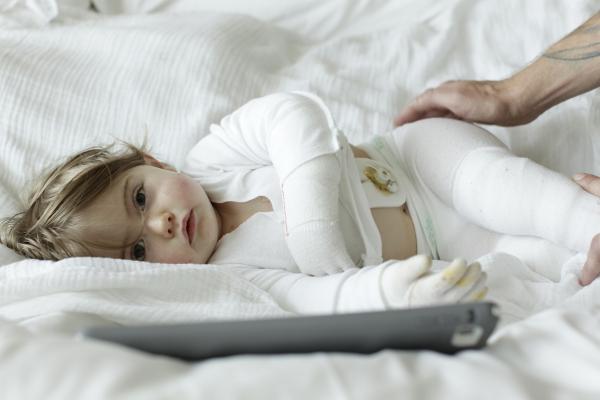
Epidermolysis Bullosa Newborn Support

You are not alone. We’re here to help you care for your baby with EB.

Here are helpful tips and medical information for caring for your newborn with Epidermolysis Bullosa (EB), plus answers to the questions new parents ask most. Have a question that isn’t answered here? Our EB Nurse Educator is here for you.
Ask our EB Nurse

Get a free care package for your baby

Our New Family Advocate program sends a free care package with wound care supplies, guides, and comfort items to families of newborns with EB.

Care for babies with EB focuses on preventing skin damage and infection, and treating complications. These tips can help.

  • Handle gently: Avoid lifting your baby from under the arms. Instead, place one hand under the bottom and the other under the head and neck. A pillow, foam (egg-crate) pad, or sheepskin under your baby can prevent friction while lifting and holding.
  • Don’t rub the skin: Friction causes blisters, so pat the skin instead of rubbing. Before blood tests or shots, clean the area by gently pressing or patting the alcohol pad against the skin.
  • Dress in loose-fitting clothes: Avoid or alter clothing with tight elastic, and avoid harsh buttons, snaps, and zippers. Use non-binding or cloth diapers, or cut the elastic from the legs of disposable diapers.
  • Avoid overheating: Heat tends to make skin more fragile. Keep a moderate temperature (including in the car) and don’t overdress your baby.
  • Never use adhesives on the skin: Tape and bandages like Band-Aids can cause blisters.
  • Lubricate the skin: Aquaphor or Vaseline helps reduce friction.
  • Wash your hands before skin care: Hand washing is the most effective way to prevent infection.
  • Don’t pull off anything stuck to the skin: Soak clothing or dressings until they come off easily, during a bath or by applying room-temperature water or a soaked compress directly to the bandage.
  • Clean the skin daily: Use a very mild soap, such as Dove.
  • Drain blisters: Blisters tend to grow if left intact, so most should be drained when they’re about the size of a dime or look tense. Use a sterile needle or lancet to puncture the side of the blister roof, making the opening large enough that it won’t reseal. Leave the blister roof in place for healing and comfort, and apply a mild antibiotic ointment.
  • Use topical antibiotics: Mild over-the-counter antibiotics (Polysporin, Bacitracin) help prevent infection and may be rotated every month or two to discourage resistance. Bactroban, like all prescription antibiotics, should be used only when infection is present (increased redness, swelling, pain, and warmth). Prolonged use has been linked to resistant staph infections.
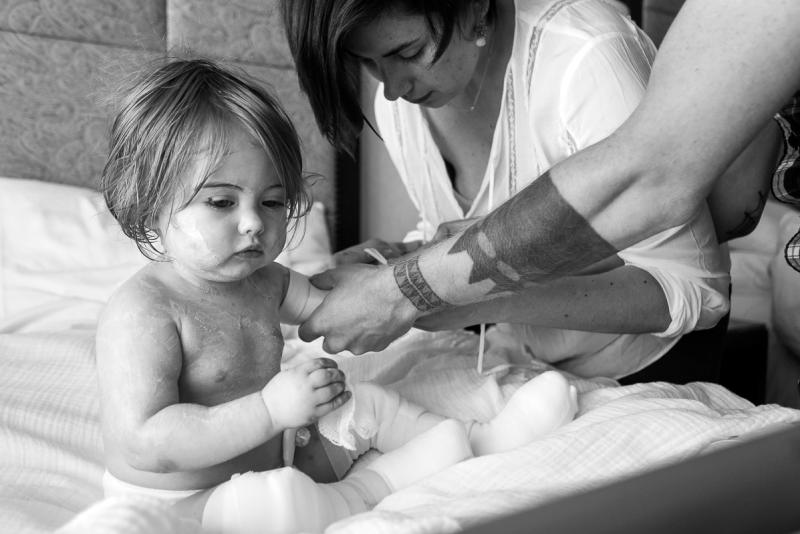
  • Apply non-adherent dressings: After the antibiotic, cover open or unprotected areas with a non-stick dressing such as Mepitel, Vaseline Gauze, or Telfa. Wrap with rolled gauze, then secure with a tubular dressing retainer to avoid tape.
  • Change dressings daily: Coordinate dressing changes with bath time. Some contact layers, like Mepitel (Mölnlycke), can stay on for several days, but change the outer dressing and check the wound daily.

Learn more in our guides to Care for Blisters and Recognize Infection.

  • Breastfeeding and bottle feeding: Breast milk is best for most babies, but nursing can be a challenge for babies with EB. Babies with blisters in the mouth may have trouble nursing or sucking from a regular bottle, so many mothers give expressed breast milk. The Medela Special Needs Feeder lets a baby feed by compressing the nipple when they can’t suck, and responds to even very weak feeding effort, working well for fragile mouths.
  • Mouth care: Gently clean your baby’s mouth with a soft sponge swab (toothette).
  • Moisten the nipple: A dry nipple can stick to lips and blisters. Moisten it with water or Vaseline before feeding.
  • Track growth: Growth charts show whether your baby’s diet is meeting their needs. If you have concerns about weight gain, talk with a nutritionist. Many babies with EB need fortified formula for extra calories and protein.

Parents and nurses sometimes avoid holding a baby with EB, hoping to prevent blisters. Learning the right way to hold your baby builds your confidence and gives your baby the closeness and comfort they need.

Make the crib a “safe place.” Do dressing changes and other uncomfortable care somewhere else, like the changing table, so your baby connects the crib with comfort.

Most parents of newborns with EB have never heard of it before their baby’s diagnosis. Here are answers to common questions.

In the United States, about 1 in 20,000 babies is born with some type of EB, or about 200 children each year.

There is no cure for EB yet. Care focuses on daily wound care, bandaging, and pain management, and FDA-approved treatments are now available for some types of EB. Learn more on our Approved Treatments page.

No. EB is an inherited genetic condition, not a contagious one. Children are born with EB because of a change in one of the genes that make certain proteins.

Some children with EB improve with age, while for others the opposite is true. It isn’t always possible to predict how EB will change based on the diagnosis alone.

No. A medical professional can make an educated guess, but initial guesses are often wrong because symptoms overlap across all the main types of EB. Only a skin biopsy or genetic testing can confirm the type.

There’s no single “right” way. Families have success with many wrapping methods and products. What matters is having a primary contact layer, a secondary layer for padding, and an outer layer to hold it all in place. Some families also wrap “high-risk” areas without wounds to help prevent damage.

It’s very hard to wrap a newborn’s fingers individually, and trying may cause more damage. You may need to wrap the hands to protect them. Placing a ball of gauze with lubricant (like white petrolatum) in the palm can keep fingertips from rubbing the base of the palm.

Some babies with EB do well in slightly larger disposable diapers with the elastic cut out; others do well in microfiber cloth diapers that wick moisture away. Most important is that urine is absorbed and not sitting against the skin.

Some feel the risk of mouth damage is too high for a newborn with EB. On the other hand, a pacifier can help with pain during things like dressing changes. Each family needs to weigh the risks and benefits.

Itching is common in EB. Keeping the skin moist with an emollient like white petrolatum can help, and some parents use a cool compress. If itching continues, talk with your physician about medication options.

Don’t see your question?

Our EB Nurse Educator is here for you, free and confidential. You can also browse our EB Care FAQ.

All medical information from debra of America is for informational purposes only and isn’t a substitute for care from a qualified physician. Please discuss all care plans with your baby’s doctor, and check with them before starting any medication or treatment.