
Epidermolysis Bullosa Bathing and Baths

Bathing is an important part of staying healthy with EB, helping protect against infections and illness.

Here’s how to make bath time gentler, including salt baths to ease stinging and bleach or vinegar baths to reduce bacteria on the skin.
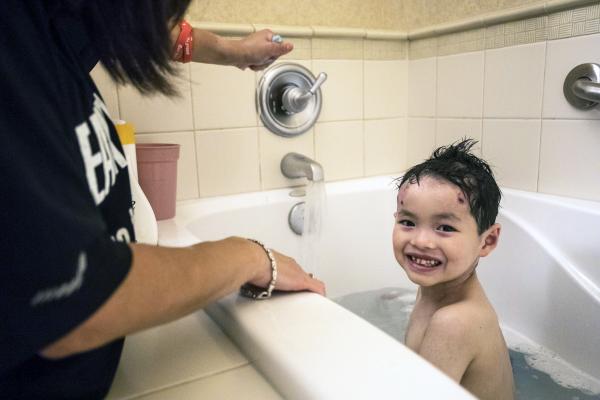
Cleansers and additives

  • Clean the skin daily.
  • Use a gentle cleanser, such as Dove soap, Hibiclens, or a saline-based solution.
  • Many people with EB add salt, bleach, or vinegar to their bathwater (see below).
  • Always mix additives into the tub water before getting in.

Tips by age

  • Infants who can’t sit up yet: sponge baths may be easier. You may need to wash and rewrap one limb at a time so the baby doesn’t rub one limb against another.
  • Older children and adults: sitting on a bath sponge in the tub can help.
  • Removing dressings: it may be easier to take dressings off while soaking.

Looking for tub liners or bath chairs? See our Daily Living product suggestions.

Adding salt to bathwater creates a pH-neutral (isotonic) solution that can lessen the sting of bathwater.

For adults

Add 2 lbs of salt to 40 gallons of water, or about a half-filled bathtub. Adjust the amount of salt to the amount of water in the tub.

For babies and infants

Add 5 teaspoons of salt to each gallon of bathwater.

Good to know

  • Table salt works fine.
  • Pool salt is inexpensive and sold in pool stores and larger retail stores in spring and summer. Buying in bulk lowers the cost.
  • Rinsing with clear water after a salt bath isn’t necessary. Salt water isn’t thought to increase itching the way bleach and vinegar can.

Special thanks to Kim Hazelbaker, RN, Sue Rowe, RN, and Jean Whalen, RN, of Cincinnati Children’s Hospital Medical Center’s EB Center, and Sharon Cassidy, RN, EB Nurse Specialist of DEBRA New Zealand, for their help preparing this section.

Bleach or vinegar can be added to bathwater to lower the amount of bacteria on the skin. They may be alternated from bath to bath.

Important Safety Notes

  • Never use bleach and vinegar together in the same bathwater.
  • Generally not recommended for babies under 1 year.
  • Both bleach and vinegar must be diluted before touching the skin.
  • Rinse with clean water afterward, or itching may get worse.

Bleach (sodium hypochlorite)

How to dilute:

  • ½ cup bleach in a full bathtub of water
  • ¼ cup bleach in a half-full bathtub
  • 1–2 teaspoons bleach in 1 gallon of water for compresses

How often (no established clinical guidelines):

  • 2–4 times a week, for 5–15 minutes each time
  • Rinse with water afterward

Bleach safety:

  • Do not swallow, drink, or splash in eyes
  • Keep out of reach of children, in a labeled, child-safe bottle
  • Never store in beverage containers
  • Do not mix with acids or ammonia
  • Know your local poison control number

White vinegar (acetic acid)

How to dilute for a bath:

  • 5% vinegar: 1 part vinegar to 20 parts bathwater
  • 3% vinegar: 1 part vinegar to 12 parts bathwater

For compresses:

  1. Soak non-stick gauze in the diluted vinegar
  2. Apply to the skin as a compress
  3. Rinse with water afterward

Vinegar has been found to help against:

  • Gram-negative bacteria, such as Pseudomonas
  • Yeast
  • Bacteria including Pseudomonas aeruginosa, Proteus vulgaris, and Acinetobacter baumannii

Adapted from “Wound Antisepsis and Your Grocery List” by Kimberly Morel, MD, presented at debra of America’s Patient Care Conference.

Questions about bath time?

Our EB Nurse Educator can help you find a bathing routine that works for you or your child. It’s free and confidential.
All medical information from debra of America is for informational purposes only and isn’t a substitute for care from a qualified physician. Please discuss all care plans with your doctor, and check with them before starting any medication or treatment.